Lehigh University Athletics
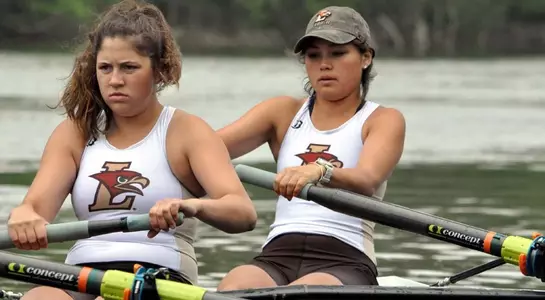
Walking on to the top boat
5/15/2014 11:16:00 AM | Women's Rowing
Patriot League Championships Preview
Like many of their teammates, Anna Eggert and Leslie Lockyer didn't start rowing until they came to Lehigh. Unlike most college sports, which are based primarily around recruited players, rowing relies heavily on walk-ons. Several rowers are recruited, but there's a need to fill out a roster with talented walk-ons.
Eggert and Lockyer have gone from learning the sport less than two years ago to sitting side-by-side in Lehigh's Varsity Eight boat as sophomores.
"Rowing is really the only sport that you can still walk on to the team with no experience and do well," said Lehigh head coach Brian Conley. "During the tryout process, we are looking for people who like to work hard. We do a wide variety of different things including running, erging, body circuits and other things like that.
If someone has never rowed before, Conley can see potential in other ways.
"We look for people with a work ethic of giving their absolute best each time they're at the boathouse," he said. "Many people will say that height is an advantage and it is, but only if the athlete is willing to work really hard, so that's why we put our focus on work ethic."
Eggert and Lockyer displayed the hard work necessary to join the team, and they have thrived. Both took huge steps forward during this past winter training.
"Anna and Leslie were always hard workers throughout their freshmen years and it was really this past winter training when they came into their own," said Conley. "They came back from winter break still in top shape and proceeded to improve every day. On days when they struggled because of exhaustion, Anna and Leslie pushed through the pain and fatigue to still pull good scores."
A Civil Engineering major out of Middlebury, Connecticut, Eggert became interested in rowing at the end of high school when a good friend entering her senior year of college was having success on Washington College's rowing team.
"Since we'd come from similar high school sports backgrounds, I felt that I too would be fit for the sport," said Eggert. "The summer before Lehigh, she taught me how to scull in a single shell and I practiced that enough so the transition to sweeping in an eight-person boat at Lehigh was not too overwhelming.
"The coaches had me on their radar as someone who was interested in the program," she continued. "However, they knew me as a swimmer and field hockey player interested in walking onto the rowing team."
A Biology major from Jackson, Mississippi, Lockyer, like many of her teammates, had no idea she would end up joining the rowing team.
"Quite honestly I had never seen rowing up front before. The closest thing that helped me make an image of it was from watching The Social Network (movie), which shows some Harvard rowing," she said. "I ultimately decided to try out because my freshman year roommate wanted to row and didn't want to try out alone. I also swam all throughout middle and high school and thoroughly enjoyed being involved with a sports team."
Rowing is an extremely demanding sport, both physically and mentally. Fighting off the urge to quit is one of the biggest challenges rowers face, especially at the beginning.
"It's a very time and energy consuming sport and at the beginning, I often questioned if it was even worth it," said Lockyer.
Another challenge is working as a unit. All rowers have to be in unison to make the boat go as fast as possible.
"I had never played a sport before that required synchronization, so it took me a while to learn that solely giving it my all physically was not going to help the boat move faster," said Eggert. "I had to work with the other girls to give our all in one fluid motion."
An interesting dynamic is the meshing of experienced rowers with inexperienced rowers who are just learning.
"We talk to our recruits that they'll be mixed with inexperienced rowers. The success of their four years is dictated by how much we help them understand the sport and what it takes," said Conley. "I think we've done a great job of bringing athletes along that had never rowed before, teaching them the sport and helping them become top contributors to our team."
"The experienced rowers reached out to make sure the new rowers were comfortable with the sport and picking it up easily," said Eggert. "I think the experienced rowers, especially those in my class, were my biggest fans in seeing that I excelled in the sport. As I grew as a rower, the relationship became closer. We could relate more in the skills we had and then push each other to be better."
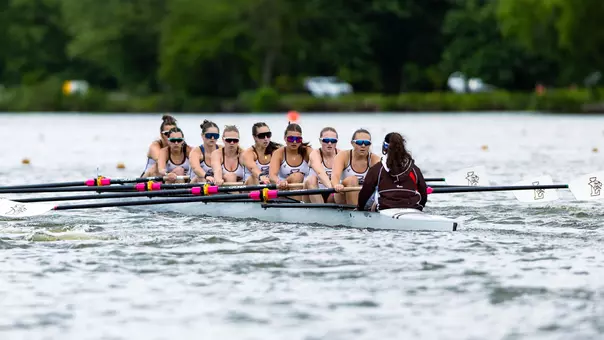
It's certainly taken a lot of hard work for both Eggert and Lockyer to earn a spot in the Varsity Eight boat. They're in the bow pair, which is opposite the coxswain. They are the first rowers to cross the finish line and are responsible for balance and important aspects like turning the boat.
"Being in the bow seat, I'm also the first person who gets hit by the headwind so I'm generally always nice and chilled," said Lockyer. "It's the best spot in the boat to wear a hoodie. We have to fight the wind with our oars while keeping the boat set. I really love my spot back there. It's a great view to see everything and nobody in the boat can see me."
"They have to be a little more sensitive and in control of their body movements since they're going to feel the boat shift a lot more than anyone else," said Conley. "So if a coxswain needs to take a turn, having that core strength and finesse to feel the boat shift out from under you and not let it affect your rowing is incredibly important."
Eggert and Lockyer have been integral parts of a highly successful Varsity Eight boat, which advanced to the semifinals of last weekend's prestigious Dad Vail Regatta. They look to make noise in the Patriot League Championships on Friday in Worcester, Massachusetts.
Both have come a long way. It felt like they were learning the sport just yesterday. There has been apprehension, but hard work has been the key factor.
"I wasn't 100 percent sure that I belonged in the top boat," said Eggert. "However, I think as we began to see results against other crews and we really started to move, I became more confident in my placement.
"Since being in the top boat, I feel that I've improved my actual stroke and learned to follow the girl in front of me," Eggert continued. "Initially, I was popping out of the bow and rushing the six other girls in front of me. Since then, I have learned to be slower out of the bow in order to set myself up for a long and slow recovery into the next stroke. This has also helped the other girls to work as one unit."
Rowing is all about unison. Each boat is one unit that makes up the bigger unit - the team. Lehigh rowing is extremely diverse in nature, but through hard work, help from coaches and experienced rowers, and a lot of practice, great things can happen. Eggert and Lockyer are two examples.
"Everybody is capable of success if they have the right attitude, and put in the time and effort." said Lockyer.
"I think we are representative of the success a walk-on can have," said Eggert. "It's interesting that of the four sophomores in the Varsity Eight, two are walk-ons and two are recruits. Of the other six rowers in the boat, three of them are walk-ons as well.
"Being young and making the Varsity Eight after just one year of experience is especially critical to the program. It shows some of the younger girls and prospects what a walk-on is capable of," Eggert continued. "I am proud to be in the Varsity Eight and think it's a privilege that I could lose at any second. So while I am proud of the seat, I have to continue working over the summer to stay in shape and get even stronger, because I know there are girls in the Second Varsity Eight who will try and work even harder than me to take that seat."
Having talented walk-ons is critically important to the program's success for that very reason, the competition it creates.
"Walk-ons like Anna and Leslie are incredibly important to the overall success of the program because it creates more competition within the team," said Conley. "The recruited athletes are always a little surprised that the walk-ons are so close to someone who just joined the sport. That challenges them out of their comfort zones. We have a great group of walk-ons and Anna and Leslie have done an amazing job throughout the year of stepping up, especially by really attacking our winter training, which can be brutal.
"Anna and Leslie are proof that anyone can step up and challenge for the top boat," Conley continued. "They are two of the shorter people in the top boat and on the team. It just takes a lot of hard work over a long period of time and without giving up. Our team has been building to that (mindset and worth ethic) over the last four years."
Like many of their teammates, Anna Eggert and Leslie Lockyer didn't start rowing until they came to Lehigh. Unlike most college sports, which are based primarily around recruited players, rowing relies heavily on walk-ons. Several rowers are recruited, but there's a need to fill out a roster with talented walk-ons.
Eggert and Lockyer have gone from learning the sport less than two years ago to sitting side-by-side in Lehigh's Varsity Eight boat as sophomores.
"Rowing is really the only sport that you can still walk on to the team with no experience and do well," said Lehigh head coach Brian Conley. "During the tryout process, we are looking for people who like to work hard. We do a wide variety of different things including running, erging, body circuits and other things like that.
If someone has never rowed before, Conley can see potential in other ways.
"We look for people with a work ethic of giving their absolute best each time they're at the boathouse," he said. "Many people will say that height is an advantage and it is, but only if the athlete is willing to work really hard, so that's why we put our focus on work ethic."
Eggert and Lockyer displayed the hard work necessary to join the team, and they have thrived. Both took huge steps forward during this past winter training.
"Anna and Leslie were always hard workers throughout their freshmen years and it was really this past winter training when they came into their own," said Conley. "They came back from winter break still in top shape and proceeded to improve every day. On days when they struggled because of exhaustion, Anna and Leslie pushed through the pain and fatigue to still pull good scores."
A Civil Engineering major out of Middlebury, Connecticut, Eggert became interested in rowing at the end of high school when a good friend entering her senior year of college was having success on Washington College's rowing team.
"Since we'd come from similar high school sports backgrounds, I felt that I too would be fit for the sport," said Eggert. "The summer before Lehigh, she taught me how to scull in a single shell and I practiced that enough so the transition to sweeping in an eight-person boat at Lehigh was not too overwhelming.
"The coaches had me on their radar as someone who was interested in the program," she continued. "However, they knew me as a swimmer and field hockey player interested in walking onto the rowing team."
A Biology major from Jackson, Mississippi, Lockyer, like many of her teammates, had no idea she would end up joining the rowing team.
"Quite honestly I had never seen rowing up front before. The closest thing that helped me make an image of it was from watching The Social Network (movie), which shows some Harvard rowing," she said. "I ultimately decided to try out because my freshman year roommate wanted to row and didn't want to try out alone. I also swam all throughout middle and high school and thoroughly enjoyed being involved with a sports team."
Rowing is an extremely demanding sport, both physically and mentally. Fighting off the urge to quit is one of the biggest challenges rowers face, especially at the beginning.
"It's a very time and energy consuming sport and at the beginning, I often questioned if it was even worth it," said Lockyer.
Another challenge is working as a unit. All rowers have to be in unison to make the boat go as fast as possible.
"I had never played a sport before that required synchronization, so it took me a while to learn that solely giving it my all physically was not going to help the boat move faster," said Eggert. "I had to work with the other girls to give our all in one fluid motion."
An interesting dynamic is the meshing of experienced rowers with inexperienced rowers who are just learning.
"We talk to our recruits that they'll be mixed with inexperienced rowers. The success of their four years is dictated by how much we help them understand the sport and what it takes," said Conley. "I think we've done a great job of bringing athletes along that had never rowed before, teaching them the sport and helping them become top contributors to our team."
"The experienced rowers reached out to make sure the new rowers were comfortable with the sport and picking it up easily," said Eggert. "I think the experienced rowers, especially those in my class, were my biggest fans in seeing that I excelled in the sport. As I grew as a rower, the relationship became closer. We could relate more in the skills we had and then push each other to be better."
It's certainly taken a lot of hard work for both Eggert and Lockyer to earn a spot in the Varsity Eight boat. They're in the bow pair, which is opposite the coxswain. They are the first rowers to cross the finish line and are responsible for balance and important aspects like turning the boat.
"Being in the bow seat, I'm also the first person who gets hit by the headwind so I'm generally always nice and chilled," said Lockyer. "It's the best spot in the boat to wear a hoodie. We have to fight the wind with our oars while keeping the boat set. I really love my spot back there. It's a great view to see everything and nobody in the boat can see me."
"They have to be a little more sensitive and in control of their body movements since they're going to feel the boat shift a lot more than anyone else," said Conley. "So if a coxswain needs to take a turn, having that core strength and finesse to feel the boat shift out from under you and not let it affect your rowing is incredibly important."
Eggert and Lockyer have been integral parts of a highly successful Varsity Eight boat, which advanced to the semifinals of last weekend's prestigious Dad Vail Regatta. They look to make noise in the Patriot League Championships on Friday in Worcester, Massachusetts.
Both have come a long way. It felt like they were learning the sport just yesterday. There has been apprehension, but hard work has been the key factor.
"I wasn't 100 percent sure that I belonged in the top boat," said Eggert. "However, I think as we began to see results against other crews and we really started to move, I became more confident in my placement.
"Since being in the top boat, I feel that I've improved my actual stroke and learned to follow the girl in front of me," Eggert continued. "Initially, I was popping out of the bow and rushing the six other girls in front of me. Since then, I have learned to be slower out of the bow in order to set myself up for a long and slow recovery into the next stroke. This has also helped the other girls to work as one unit."
Rowing is all about unison. Each boat is one unit that makes up the bigger unit - the team. Lehigh rowing is extremely diverse in nature, but through hard work, help from coaches and experienced rowers, and a lot of practice, great things can happen. Eggert and Lockyer are two examples.
"Everybody is capable of success if they have the right attitude, and put in the time and effort." said Lockyer.
"I think we are representative of the success a walk-on can have," said Eggert. "It's interesting that of the four sophomores in the Varsity Eight, two are walk-ons and two are recruits. Of the other six rowers in the boat, three of them are walk-ons as well.
"Being young and making the Varsity Eight after just one year of experience is especially critical to the program. It shows some of the younger girls and prospects what a walk-on is capable of," Eggert continued. "I am proud to be in the Varsity Eight and think it's a privilege that I could lose at any second. So while I am proud of the seat, I have to continue working over the summer to stay in shape and get even stronger, because I know there are girls in the Second Varsity Eight who will try and work even harder than me to take that seat."
Having talented walk-ons is critically important to the program's success for that very reason, the competition it creates.
"Walk-ons like Anna and Leslie are incredibly important to the overall success of the program because it creates more competition within the team," said Conley. "The recruited athletes are always a little surprised that the walk-ons are so close to someone who just joined the sport. That challenges them out of their comfort zones. We have a great group of walk-ons and Anna and Leslie have done an amazing job throughout the year of stepping up, especially by really attacking our winter training, which can be brutal.
"Anna and Leslie are proof that anyone can step up and challenge for the top boat," Conley continued. "They are two of the shorter people in the top boat and on the team. It just takes a lot of hard work over a long period of time and without giving up. Our team has been building to that (mindset and worth ethic) over the last four years."
MHT EP15 - Rowing
Friday, April 10
2026 Rowing Spring Preview
Friday, March 27
Rowing Season Preview
Friday, March 28
Lehigh Sports Central: Rowing
Wednesday, April 24