Lehigh University Athletics
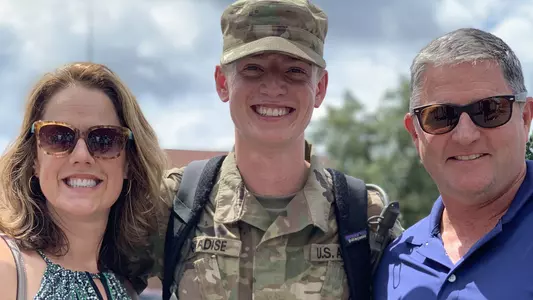
Paradise’s Passion for Serving
8/6/2020 2:56:00 PM | Men's Cross Country, Men's Track and Field, Support, Features, Flight 45, Intellectual Development
By: Justin Lafleur, Lehigh Sports Communications
Over his four years at Lehigh, recent cross country/track and field graduate Ryan Paradise '20 focused on development in all aspects of his life.
Development came not only as a student and athlete, but also as a member of Lehigh's Steel Battalion Army ROTC (Reserve Officers' Training Corps) Program.
"Both my parents did ROTC at Notre Dame," said Paradise, who majored in mechanical engineering. "Hearing about their experiences and what they learned from their time in the Army was a big factor in me going that route.
"I also felt really compelled to the service aspect of the military."
There are a number of ways to reach the end goal of serving one's country.
For example, someone can attend (fellow Patriot League schools) Army West Point or Navy.
Then there's also ROTC.
"ROTC is another way you can still get a college education and receive that training in hopes to eventually commission as an officer in one of the armed forces," said Paradise.
What exactly does training entail?
"In the mornings, we went for runs and did push-ups, sit-ups and other calisthenics," said Paradise. "A couple times a week, we had military science class. It's a progressive approach; you come in in your first year and really learn bare bones, Army skills – like customs, courtesies and the Army structure."

It even gets to a point where seniors run the ROTC program, with guidance from commanding officers.
"The senior-level class is all about how to lead an organization," said Paradise. "It gives you experience with your peers and allows you to struggle through the different problems you have to solve."
Leadership is a common theme throughout not only Paradise's life, but also ROTC and Division I college athletics. Leadership is needed during mandatory training for all ROTC students, which comes between junior and senior year.
The 38-day training takes place at Advanced Camp in Fort Knox, Kentucky.
"It's the first time a lot of people are on a military instillation and communicating with different military leaders who aren't part of our specific ROTC programs," said Paradise. "It's pretty intimidating and humbling. Going into an environment like that can definitely be uncomfortable and you have to figure out how to navigate peer-to-peer leadership."
The camp is very experiential, an opportunity to learn through doing. Cadets go through rotations where they're leaders of platoons (a room of around 40 people).
"You may find out the kind of leader you want to be because people were responsive to a certain style," said Paradise. "You spend some days at the range and learn how to shoot a rifle. You also spend time on the land navigation course, figuring out how to get to different points and plotting points on maps."
Significant time is spent in the woods doing lane training missions.
"You're on a mission and have to figure out the tactics involved with platoon operations – for example, ambushing an enemy," said Paradise. "You learn a whole lot of other skills that are relevant and important to being an officer in the Army.
"The overall experience is very challenging, but also rewarding because you learn a lot about yourself, especially your strengths and weaknesses in the area of leadership."

Paradise's leadership training has been working. Last October, he won a prestigious national award through the Association of the United States Army.
"Several cadets on a regional level were recognized based off areas like merit and scholarship," said Paradise. "I made it through the rounds within our region, which is called our brigade, and I actually ended up being awarded the national prize as the top cadet in the nation."
Despite all his honors and accomplishments, Paradise is level-headed, extremely humble and knows he hasn't "arrived." In fact, it's quite the opposite; he knows there's always room for improvement.
"Through all my experiences (across academics, athletics and ROTC), I've been able to see different leadership styles and exercise leadership in different domains," said Paradise. "Military leadership is different than leadership on a sports team, but at the same time, there are some key components that can be applied universally."
Another area of growth for Paradise has been communication.
"I've figured out how to articulate a message really well and concisely, and communicate with senior officers," he said. "That stemmed from both ROTC and the Lehigh Athletics Leadership Academy (called Flight 45)."

Paradise learned leadership from being a cross country/track and field team member as well.
"Like so many of our student-athletes, Ryan came to Lehigh from a great family with a willingness to take on some big challenges," said Lehigh head men's cross country coach Todd Etters. "One thing that stood out to me right away was his growth mindset. He has certainly had a lot of success in his life, but I have seen the most growth out of him when he has struggled or even failed.
"Ryan is never afraid or ashamed of failure," Etters continued. "Embracing a difficult challenge without knowing for sure if you will succeed is not an easy task for anyone. The challenge of balancing an engineering degree, while in ROTC and competing as a multi-sport Division I athlete, is immense. However, Ryan knows these types of challenges truly make you a better person."
Today, Paradise is a better person due to his breadth of experiences, and he knows those experiences wouldn't have been possible without the longstanding support from all his coaches.
"When I was getting recruited by Coach Etters, I explained my intention to do ROTC," said Paradise. "There had been a few student-athletes, at least on the track and field/cross country side of things, that had done it previously. Coach Matt and Coach Deb (Utesch) had seen it before and had seen it work."
In Paradise's case, it has worked because of teamwork and flexibility.
"Coach Etters, who I worked with the most, was really helpful in getting me the kind of balance in my training to allow me to perform at my peak athletically," he said. "A lot was on me to communicate what I did earlier in the day (at ROTC). If I had a hard physical training session in the morning, then a workout in the afternoon for cross country, it was on me to tell Coach Etters. In that case, we would adjust my training."
College is a time for students to learn about themselves; they enter as a boy/girl and leave as a man/woman.
That is certainly true for Paradise.
"I learned I am a very task-oriented person, who really likes to get things done, figure out the process and go through a step-by-step list," he said. "And if a problem comes up, I like to focus on figuring out a solution."
Through learning he is task-oriented (a good thing), Paradise also recognized he wasn't as focused on the people around him as he needed to be.
"Being an empathetic leader wasn't one of my strengths, so I really tried to focus on that, especially as a junior and senior," he said. "To know yourself, you have to know what you're good at and leverage your abilities.
"You also have to be humble enough to identify weaknesses."
"Ryan is a great example of learning leadership skills and then applying and honing them in real-world situations," said Etters. "I am so humbled to have had the opportunity to coach him and I am extremely proud of what he has done and where he's going.
"He has a team-first attitude and his teammates, classmates, fellow soldiers and our country are all beneficiaries of his efforts," Etters continued. "Ryan is the kind of guy you can build the proper culture around and if you have that, anything is possible."

Proper culture comes from the right people, and it's the people who truly make Paradise so passionate about serving.
"I've come to realize when you join the Army and make the commitment to be an officer, it's all about the people around you," said Paradise. "Being put in charge of a group of people is rewarding and gets me really excited about the future."
The future is bright. In the present, Paradise has earned his commission as second lieutenant in the United States Army.
As he said, "We then have the responsibility of fulfilling a four-year service commitment."
Paradise is currently at Fort Leonard Wood in Missouri completing his Engineering Basic Officers Leadership Course.
"I'm training very specifically on my technical engineering skills and how to be a leader as an engineer in the Army," he said. "That training will last until December, and then in January, I will move to Colorado Springs, Colorado. Fort Carson will be my first duty station assignment.
"I'll be there for probably a couple years with possibly some periods of time when I receive some additional training, or get deployed somewhere."
No matter where Paradise is located, it's safe to say he will make an impact.
Paradise's Lehigh student-athlete/ROTC experience, coupled with a growth mindset, will only help him continue to learn, grow and lead as he serves our country.
"The resume that Ryan has put together, and continues to build upon, is something our entire Lehigh community can be proud of," said Etters. "He never took the easy way out and he thrived in the challenging environment that Lehigh is capable of providing.
"In my mind, that's what makes Lehigh special and Ryan took full advantage of it."
Paradise has the mentality that he's never going to know everything.
"Nobody's ever going to be a perfect leader," he said. "There's always more to learn. If I keep reminding myself to not be complacent, I'll continually challenge myself to get better and be a better leader.
"I am definitely proud of my growth throughout college, but I know there's no end to that development as I progress in my career."

Over his four years at Lehigh, recent cross country/track and field graduate Ryan Paradise '20 focused on development in all aspects of his life.
Development came not only as a student and athlete, but also as a member of Lehigh's Steel Battalion Army ROTC (Reserve Officers' Training Corps) Program.
"Both my parents did ROTC at Notre Dame," said Paradise, who majored in mechanical engineering. "Hearing about their experiences and what they learned from their time in the Army was a big factor in me going that route.
"I also felt really compelled to the service aspect of the military."
There are a number of ways to reach the end goal of serving one's country.
For example, someone can attend (fellow Patriot League schools) Army West Point or Navy.
Then there's also ROTC.
"ROTC is another way you can still get a college education and receive that training in hopes to eventually commission as an officer in one of the armed forces," said Paradise.
What exactly does training entail?
"In the mornings, we went for runs and did push-ups, sit-ups and other calisthenics," said Paradise. "A couple times a week, we had military science class. It's a progressive approach; you come in in your first year and really learn bare bones, Army skills – like customs, courtesies and the Army structure."
It even gets to a point where seniors run the ROTC program, with guidance from commanding officers.
"The senior-level class is all about how to lead an organization," said Paradise. "It gives you experience with your peers and allows you to struggle through the different problems you have to solve."
Leadership is a common theme throughout not only Paradise's life, but also ROTC and Division I college athletics. Leadership is needed during mandatory training for all ROTC students, which comes between junior and senior year.
The 38-day training takes place at Advanced Camp in Fort Knox, Kentucky.
"It's the first time a lot of people are on a military instillation and communicating with different military leaders who aren't part of our specific ROTC programs," said Paradise. "It's pretty intimidating and humbling. Going into an environment like that can definitely be uncomfortable and you have to figure out how to navigate peer-to-peer leadership."
The camp is very experiential, an opportunity to learn through doing. Cadets go through rotations where they're leaders of platoons (a room of around 40 people).
"You may find out the kind of leader you want to be because people were responsive to a certain style," said Paradise. "You spend some days at the range and learn how to shoot a rifle. You also spend time on the land navigation course, figuring out how to get to different points and plotting points on maps."
Significant time is spent in the woods doing lane training missions.
"You're on a mission and have to figure out the tactics involved with platoon operations – for example, ambushing an enemy," said Paradise. "You learn a whole lot of other skills that are relevant and important to being an officer in the Army.
"The overall experience is very challenging, but also rewarding because you learn a lot about yourself, especially your strengths and weaknesses in the area of leadership."
Paradise's leadership training has been working. Last October, he won a prestigious national award through the Association of the United States Army.
"Several cadets on a regional level were recognized based off areas like merit and scholarship," said Paradise. "I made it through the rounds within our region, which is called our brigade, and I actually ended up being awarded the national prize as the top cadet in the nation."
Despite all his honors and accomplishments, Paradise is level-headed, extremely humble and knows he hasn't "arrived." In fact, it's quite the opposite; he knows there's always room for improvement.
"Through all my experiences (across academics, athletics and ROTC), I've been able to see different leadership styles and exercise leadership in different domains," said Paradise. "Military leadership is different than leadership on a sports team, but at the same time, there are some key components that can be applied universally."
Another area of growth for Paradise has been communication.
"I've figured out how to articulate a message really well and concisely, and communicate with senior officers," he said. "That stemmed from both ROTC and the Lehigh Athletics Leadership Academy (called Flight 45)."
Paradise learned leadership from being a cross country/track and field team member as well.
"Like so many of our student-athletes, Ryan came to Lehigh from a great family with a willingness to take on some big challenges," said Lehigh head men's cross country coach Todd Etters. "One thing that stood out to me right away was his growth mindset. He has certainly had a lot of success in his life, but I have seen the most growth out of him when he has struggled or even failed.
"Ryan is never afraid or ashamed of failure," Etters continued. "Embracing a difficult challenge without knowing for sure if you will succeed is not an easy task for anyone. The challenge of balancing an engineering degree, while in ROTC and competing as a multi-sport Division I athlete, is immense. However, Ryan knows these types of challenges truly make you a better person."
Today, Paradise is a better person due to his breadth of experiences, and he knows those experiences wouldn't have been possible without the longstanding support from all his coaches.
"When I was getting recruited by Coach Etters, I explained my intention to do ROTC," said Paradise. "There had been a few student-athletes, at least on the track and field/cross country side of things, that had done it previously. Coach Matt and Coach Deb (Utesch) had seen it before and had seen it work."
In Paradise's case, it has worked because of teamwork and flexibility.
"Coach Etters, who I worked with the most, was really helpful in getting me the kind of balance in my training to allow me to perform at my peak athletically," he said. "A lot was on me to communicate what I did earlier in the day (at ROTC). If I had a hard physical training session in the morning, then a workout in the afternoon for cross country, it was on me to tell Coach Etters. In that case, we would adjust my training."
College is a time for students to learn about themselves; they enter as a boy/girl and leave as a man/woman.
That is certainly true for Paradise.
"I learned I am a very task-oriented person, who really likes to get things done, figure out the process and go through a step-by-step list," he said. "And if a problem comes up, I like to focus on figuring out a solution."
Through learning he is task-oriented (a good thing), Paradise also recognized he wasn't as focused on the people around him as he needed to be.
"Being an empathetic leader wasn't one of my strengths, so I really tried to focus on that, especially as a junior and senior," he said. "To know yourself, you have to know what you're good at and leverage your abilities.
"You also have to be humble enough to identify weaknesses."
"Ryan is a great example of learning leadership skills and then applying and honing them in real-world situations," said Etters. "I am so humbled to have had the opportunity to coach him and I am extremely proud of what he has done and where he's going.
"He has a team-first attitude and his teammates, classmates, fellow soldiers and our country are all beneficiaries of his efforts," Etters continued. "Ryan is the kind of guy you can build the proper culture around and if you have that, anything is possible."
Proper culture comes from the right people, and it's the people who truly make Paradise so passionate about serving.
"I've come to realize when you join the Army and make the commitment to be an officer, it's all about the people around you," said Paradise. "Being put in charge of a group of people is rewarding and gets me really excited about the future."
The future is bright. In the present, Paradise has earned his commission as second lieutenant in the United States Army.
As he said, "We then have the responsibility of fulfilling a four-year service commitment."
Paradise is currently at Fort Leonard Wood in Missouri completing his Engineering Basic Officers Leadership Course.
"I'm training very specifically on my technical engineering skills and how to be a leader as an engineer in the Army," he said. "That training will last until December, and then in January, I will move to Colorado Springs, Colorado. Fort Carson will be my first duty station assignment.
"I'll be there for probably a couple years with possibly some periods of time when I receive some additional training, or get deployed somewhere."
No matter where Paradise is located, it's safe to say he will make an impact.
Paradise's Lehigh student-athlete/ROTC experience, coupled with a growth mindset, will only help him continue to learn, grow and lead as he serves our country.
"The resume that Ryan has put together, and continues to build upon, is something our entire Lehigh community can be proud of," said Etters. "He never took the easy way out and he thrived in the challenging environment that Lehigh is capable of providing.
"In my mind, that's what makes Lehigh special and Ryan took full advantage of it."
Paradise has the mentality that he's never going to know everything.
"Nobody's ever going to be a perfect leader," he said. "There's always more to learn. If I keep reminding myself to not be complacent, I'll continually challenge myself to get better and be a better leader.
"I am definitely proud of my growth throughout college, but I know there's no end to that development as I progress in my career."

Players Mentioned

Sprint/Mid-Distance
/ Men's Track and FieldLehigh Sports Central: Men's Cross Country
Wednesday, October 01
2025 Lehigh Men's Cross Country Season Preview
Thursday, August 28
Lehigh Sports Central: Men's Cross Country
Wednesday, October 02
2024 Men's Cross Country season preview
Thursday, August 29