Lehigh University Athletics
Dykes ’66 Keeps on Running
12/26/2018 12:16:00 PM | Men's Track and Field, Features
By: Justin Lafleur, Lehigh Sports Communications
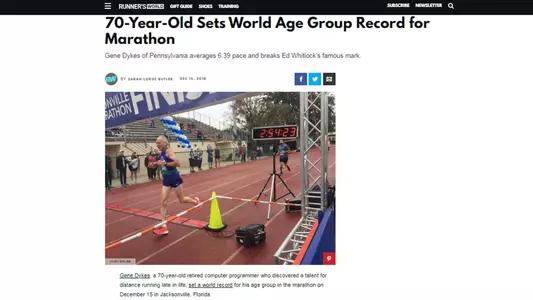
On Dec. 15 in Jacksonville, Florida, Lehigh alumnus Gene Dykes, age 70, set a world age group record for a marathon – finishing in 2:54.23, breaking the previous mark of 2:54.48 set by Ed Whitlock.
Unfortunately, despite assurances from the race director, the proper sanctioning paperwork had not been submitted beforehand, so the record is not likely to be ratified, but no one doubts that Dykes legitimately went where nobody over the age of 70 had ever gone before.
Interestingly enough, although Dykes competed in track and field at Lehigh, his running truly took off after his Lehigh days. With all the success and fame he is earning today, it wasn't always the case. Dykes faced plenty of struggles along the way, including in his time at Lehigh, which helped mold him into the competitor – and person – he is today.
"Lehigh was definitely an interesting landmark in my running career," said Dykes. "I started running in middle school before the very first running craze when people would stare and dogs would go insane like you were some kind of alien.
"Then I got to Lehigh, and it was terrible," he continued. "I was totally blown off the track by the talent at the college level. I was hardly competitive. Rarely, would I even get a third-place point."
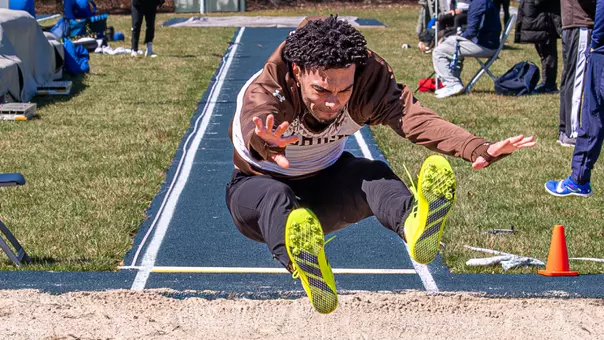
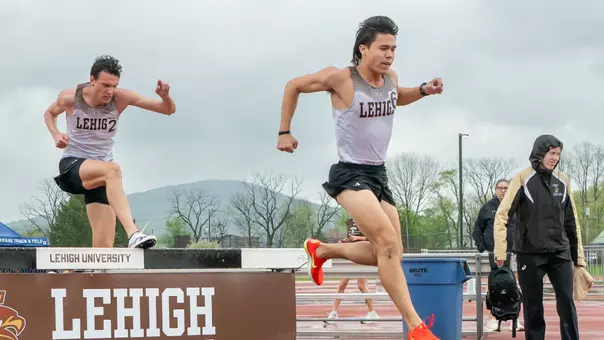
Dykes ended up competing in events like the triple jump, intermediate hurdles, and high jump, picking up points that way.
"I was helpful on the team, but just not much on the track," he said. "The experience made it firmly entrenched in my mind that I was a mediocre runner and there was no use for me to pursue racing after graduation."
As he grew older, Dykes jogged and stayed in shape, but then in his late 50s, he was encouraged by friends to run a race.
And as they say, the rest is history.
"I ran my first road race, a half marathon, and did pretty well," said Dykes. "It was enjoyable, so I started doing lots of races and I just kept getting better and better. New York City was my first marathon in 2006 and about six years later (in 2012), I ran the Toronto marathon hoping to set a new personal record, but came up woefully short. From there, I hired a coach and boy, my career really took off. I couldn't believe how much he improved my game. Within five months, my marathon time improved by 20 minutes. I finished third in my age group in Boston and kept getting better every year since.
"I'm still improving."
It's pretty clear that Dykes has found his calling. Struggling with shorter distances at Lehigh, he now doesn't bat an eye about half marathons, marathons, races of 100 miles or even longer.
"One hundred milers only started a little over 30 years ago," he said. "There used to be only four or five of them, but now there have to be at least 100 in the United States. Those usually take about 24 hours; cutoff is usually around 32 hours and the really good runners can do it down around 14 hours.
"Five years ago, this race director on the West Coast said it's time to step up the game, so she invented the Tahoe 200, which was a single loop around Lake Tahoe," Dykes continued. "Two hundred unique miles. The next year, she had another 200-mile race called the Bigfoot 200, which is in Washington State. It runs around Mount St. Helens and past Mount Adams towards Mount Rainier. Totally awesome. A third, the Moab 240 Endurance Run (a 238.3 mile race) was added last year, and that's when I ran all three of them in a span of three months."
Dykes truly enjoys the challenge of racing, along with the camaraderie that running brings. How does he get through such long and grueling races?
"Time and distance take on all-new meaning," he said. "The winners will run 200 miles in about two and a half days, around 60 hours. They give you up to about 100 hours to finish. A lot of people think that's an impossible distance because the farther they run, the more tired they get.
"The way I look at it is at some point, you run out of glycogen and 'hit the wall.' But after that, it doesn't get any worse. You're surviving on fat and whatever you can eat. It's just a matter of keeping on keeping on."
As Dykes explained, "What used to be an intolerably slow pace feels fast after a while.
"Imagine saying to yourself that it's only six more hours to the next aid station. Hours don't mean anything in a race that long."
Sleep deprivation is a significant challenge in a race so long. It takes tremendous will power to get through.
"You run until you can't stand anymore, then take a two-hour cat nap," said Dykes. "That's enough to keep you going for another 20 or so hours, until you have to grab another nap."
Marathon races can slow people down, but for Dykes, it's what keeps him going.
"You start building a community of friends that you see at races," he said. "Training is something you look forward to every day. If you didn't have these friends, you'd wake up in the morning and just go back to bed. The community gets you out of bed and onto the trail."
Dykes could have never imagined himself doing what he's doing today, after facing struggles at Lehigh.
"Sometimes, you just have to wait for the time to be right," he said. "Maybe running wasn't right for me earlier, but it was later. Winning isn't so important, but doing as well as I can is always important. Of course, winning is a benchmark, but I'm always out to beat my most fierce competitor -- which is me from the previous year."
Earlier this month, Dykes beat himself, and the previous world age group record.
Even though Dykes' running career took off after his time at Lehigh, his time at Lehigh truly set the stage for the rest of his life. A number of lessons from his college days stay with him to this day, both as an athlete and student.
"Track of course added a little humility to me," said Dykes. "There is always somebody better than you and I was certainly taught that lesson in track. I learned a lot of valuable lessons at Lehigh. I went there thinking I'd be an engineer, but that lasted one semester. I went to see the Dean and said I didn't know what I should study. He asked me something totally obvious which pretty much changed my life… 'What did you enjoy studying in high school?'
"I said I liked biology. It was like a revelation; of course you should study what you enjoy. I enjoyed chemistry classes, so I took those as electives while I was doing biology and I ended up switching into a chemistry major my second semester senior year and graduated on time because I only needed to make up one course. That was life-changing."
Another lesson Dykes learned was keeping an eye out for new opportunities.
"I was walking down the hall one day and there was this notice on the wall that said 'computer programming seminar tonight,'" he said. "I thought it might be interesting. After the first session, I was totally hooked and ended up becoming a computer programmer my entire career. Even though I got a PhD in biochemistry at Cornell, it was computer programming that I pursued.
"Do what you enjoy and don't be afraid to change course," Dykes continued.
That sentence certainly defines Gene Dykes. In competitive distance running, Dykes has found something he enjoys. To reach where he is today as a world record holder, he has undoubtedly changed course.
"Over the past 12 years, I've had 13 marathon personal records," he said. "Each one has been easier.
"Once you're in shape, you're running within your capabilities instead of trying to outrun your capabilities."
On Dec. 15 in Jacksonville, Florida, Lehigh alumnus Gene Dykes, age 70, set a world age group record for a marathon – finishing in 2:54.23, breaking the previous mark of 2:54.48 set by Ed Whitlock.
Unfortunately, despite assurances from the race director, the proper sanctioning paperwork had not been submitted beforehand, so the record is not likely to be ratified, but no one doubts that Dykes legitimately went where nobody over the age of 70 had ever gone before.
Interestingly enough, although Dykes competed in track and field at Lehigh, his running truly took off after his Lehigh days. With all the success and fame he is earning today, it wasn't always the case. Dykes faced plenty of struggles along the way, including in his time at Lehigh, which helped mold him into the competitor – and person – he is today.
"Lehigh was definitely an interesting landmark in my running career," said Dykes. "I started running in middle school before the very first running craze when people would stare and dogs would go insane like you were some kind of alien.
"Then I got to Lehigh, and it was terrible," he continued. "I was totally blown off the track by the talent at the college level. I was hardly competitive. Rarely, would I even get a third-place point."
Dykes ended up competing in events like the triple jump, intermediate hurdles, and high jump, picking up points that way.
"I was helpful on the team, but just not much on the track," he said. "The experience made it firmly entrenched in my mind that I was a mediocre runner and there was no use for me to pursue racing after graduation."
As he grew older, Dykes jogged and stayed in shape, but then in his late 50s, he was encouraged by friends to run a race.
And as they say, the rest is history.
"I ran my first road race, a half marathon, and did pretty well," said Dykes. "It was enjoyable, so I started doing lots of races and I just kept getting better and better. New York City was my first marathon in 2006 and about six years later (in 2012), I ran the Toronto marathon hoping to set a new personal record, but came up woefully short. From there, I hired a coach and boy, my career really took off. I couldn't believe how much he improved my game. Within five months, my marathon time improved by 20 minutes. I finished third in my age group in Boston and kept getting better every year since.
"I'm still improving."
It's pretty clear that Dykes has found his calling. Struggling with shorter distances at Lehigh, he now doesn't bat an eye about half marathons, marathons, races of 100 miles or even longer.
"One hundred milers only started a little over 30 years ago," he said. "There used to be only four or five of them, but now there have to be at least 100 in the United States. Those usually take about 24 hours; cutoff is usually around 32 hours and the really good runners can do it down around 14 hours.
"Five years ago, this race director on the West Coast said it's time to step up the game, so she invented the Tahoe 200, which was a single loop around Lake Tahoe," Dykes continued. "Two hundred unique miles. The next year, she had another 200-mile race called the Bigfoot 200, which is in Washington State. It runs around Mount St. Helens and past Mount Adams towards Mount Rainier. Totally awesome. A third, the Moab 240 Endurance Run (a 238.3 mile race) was added last year, and that's when I ran all three of them in a span of three months."
Dykes truly enjoys the challenge of racing, along with the camaraderie that running brings. How does he get through such long and grueling races?
"Time and distance take on all-new meaning," he said. "The winners will run 200 miles in about two and a half days, around 60 hours. They give you up to about 100 hours to finish. A lot of people think that's an impossible distance because the farther they run, the more tired they get.
"The way I look at it is at some point, you run out of glycogen and 'hit the wall.' But after that, it doesn't get any worse. You're surviving on fat and whatever you can eat. It's just a matter of keeping on keeping on."
As Dykes explained, "What used to be an intolerably slow pace feels fast after a while.
"Imagine saying to yourself that it's only six more hours to the next aid station. Hours don't mean anything in a race that long."
Sleep deprivation is a significant challenge in a race so long. It takes tremendous will power to get through.
"You run until you can't stand anymore, then take a two-hour cat nap," said Dykes. "That's enough to keep you going for another 20 or so hours, until you have to grab another nap."
Marathon races can slow people down, but for Dykes, it's what keeps him going.
"You start building a community of friends that you see at races," he said. "Training is something you look forward to every day. If you didn't have these friends, you'd wake up in the morning and just go back to bed. The community gets you out of bed and onto the trail."
Dykes could have never imagined himself doing what he's doing today, after facing struggles at Lehigh.
"Sometimes, you just have to wait for the time to be right," he said. "Maybe running wasn't right for me earlier, but it was later. Winning isn't so important, but doing as well as I can is always important. Of course, winning is a benchmark, but I'm always out to beat my most fierce competitor -- which is me from the previous year."
Earlier this month, Dykes beat himself, and the previous world age group record.
Even though Dykes' running career took off after his time at Lehigh, his time at Lehigh truly set the stage for the rest of his life. A number of lessons from his college days stay with him to this day, both as an athlete and student.
"Track of course added a little humility to me," said Dykes. "There is always somebody better than you and I was certainly taught that lesson in track. I learned a lot of valuable lessons at Lehigh. I went there thinking I'd be an engineer, but that lasted one semester. I went to see the Dean and said I didn't know what I should study. He asked me something totally obvious which pretty much changed my life… 'What did you enjoy studying in high school?'
"I said I liked biology. It was like a revelation; of course you should study what you enjoy. I enjoyed chemistry classes, so I took those as electives while I was doing biology and I ended up switching into a chemistry major my second semester senior year and graduated on time because I only needed to make up one course. That was life-changing."
Another lesson Dykes learned was keeping an eye out for new opportunities.
"I was walking down the hall one day and there was this notice on the wall that said 'computer programming seminar tonight,'" he said. "I thought it might be interesting. After the first session, I was totally hooked and ended up becoming a computer programmer my entire career. Even though I got a PhD in biochemistry at Cornell, it was computer programming that I pursued.
"Do what you enjoy and don't be afraid to change course," Dykes continued.
That sentence certainly defines Gene Dykes. In competitive distance running, Dykes has found something he enjoys. To reach where he is today as a world record holder, he has undoubtedly changed course.
"Over the past 12 years, I've had 13 marathon personal records," he said. "Each one has been easier.
"Once you're in shape, you're running within your capabilities instead of trying to outrun your capabilities."


MHT EP14 - Track & Field
Friday, April 03
2026 Rowing Spring Preview
Friday, March 27
2026 GD+MM Thank You
Thursday, March 26
MHT EP13 - Baseball
Wednesday, March 25